Key points at a glance
Every year around Diwali, the same conversation starts in Indian homes. A rishta is almost fixed, the families have met twice, and someone's chacha says, "Wait for Dev Uthani, then we will talk about the date." If that sounds like your house, you are not alone. Dev Uthani Ekadashi 2026 is the day many families wait for, because it marks the traditional reopening of the wedding season. Before you circle a date, check the day on our Mahurat tool and read the tithi timings below carefully.
Get your wedding date checked: talk to a HealAstro astrologer
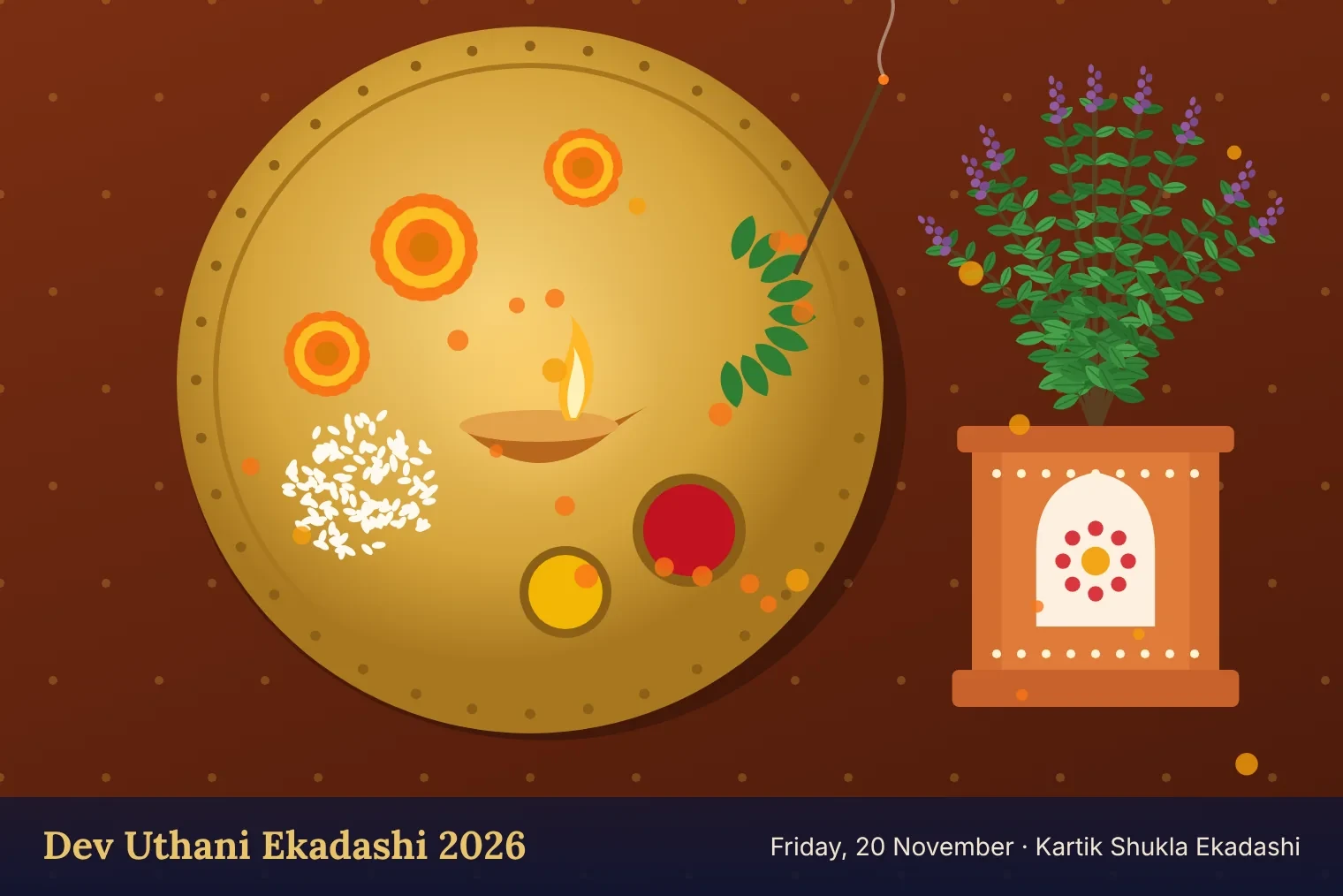
Dev Uthani Ekadashi 2026 is the Ekadashi of the Kartik Shukla paksha (bright fortnight), observed on 20 November 2026. Tradition says Lord Vishnu wakes from his four-month sleep on this day. Devotees fast, worship Vishnu and Tulsi, and families begin planning weddings and other auspicious work that were paused during Chaturmas.
The date depends on which tradition you follow, because the Ekadashi tithi starts on one day and ends on the next. The timings below are for New Delhi and were cross-checked on 4 November 2026 against two panchang sources.
| Detail | 2026 timing (New Delhi) |
|---|---|
| Ekadashi tithi begins | Friday, 20 November, 7:16 AM |
| Ekadashi tithi ends | Saturday, 21 November, 6:32 AM |
| Fast for most Smarta households | Friday, 20 November |
| Fast in the Vaishnava (gauna) tradition | Saturday, 21 November |
| Tulsi Vivah | Evening of 20 November in many homes; 21 November in others |
| Parana | Next morning after sunrise, within Dwadashi, outside Hari Vasara |
One honest caution. Panchang sites do not always agree on the parana clock time, and we found two different figures while preparing this page. Timings also shift by city, sometimes by several minutes. Please confirm your own city on our Panchang page before you break your fast. If your family follows a particular guru or sampradaya, go with the date they announce.
If your family has always kept Ekadashi on the first day it appears, you will most likely fast on 20 November. Families who follow Vaishnava custom, often devotees of Vishnu and Krishna in Mathura, Vrindavan and parts of Bengal and Odisha, keep the fast on the second day. When in doubt, ask the elder who has kept the vrat for decades. That person is usually right.
Dev Uthani Ekadashi ends Chaturmas because, as traditional accounts say, Lord Vishnu goes into yoga-nidra (divine sleep) on Devshayani Ekadashi in Ashadha and wakes on this Kartik Ekadashi. During those months, weddings, griha pravesh (housewarming) and similar samskaras are traditionally avoided.
So the day is a gate, not a wedding date in itself. Many families sound surprised when we say this. Marriage muhurats reopen after Dev Uthani, but each muhurat still depends on the panchang for that specific day: the nakshatra, the tithi, and the condition of Guru (Jupiter) and Shukra (Venus) in the sky. Classical texts such as the Muhurta Chintamani discuss these rules in detail. If Guru or Shukra is combust (asta), many astrologers advise postponing the wedding even when the calendar looks open.
Observing the vrat means waking early, bathing, taking the sankalp (resolve) to fast, and worshipping Vishnu through the day. The steps below follow common household practice. Your family tradition may differ slightly.
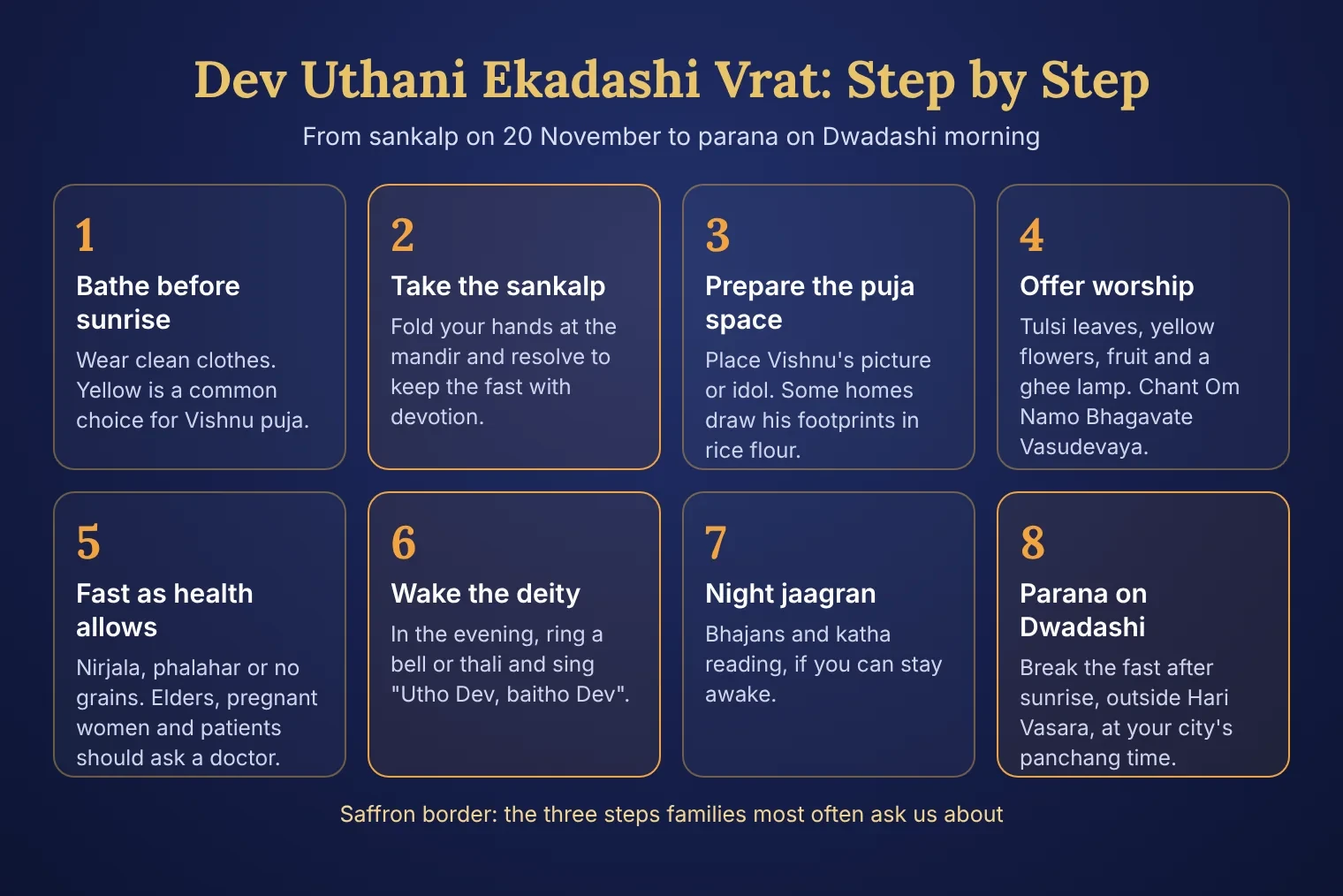
Traditionally, rice and other grains, lentils, onion and garlic are avoided. Arguments and harsh speech are avoided too, and that last rule is the hardest in a joint family during wedding season.
Browse more fasting dates on our Vrat and Upvaas page
Tulsi Vivah is the ceremonial marriage of the Tulsi plant, seen as a form of Goddess Lakshmi, with a Shaligram stone or an idol of Vishnu, and it begins the wedding season symbolically. It is held on the evening of Ekadashi in many homes and on 21 November in others, so check which your family follows.
A simple home vidhi looks like this:
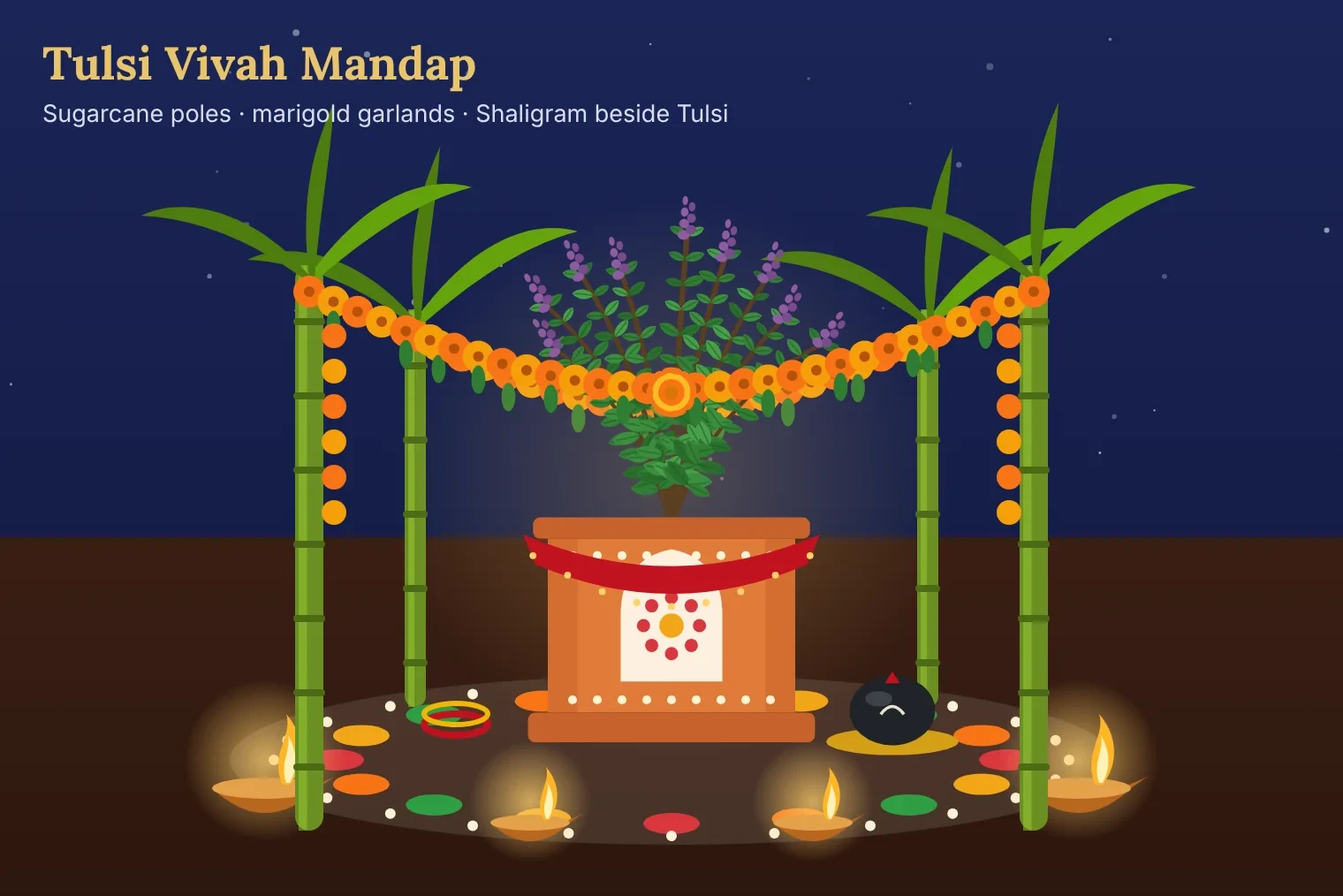
Some families invite a neighbour's child to play the groom's side. It is a warm, noisy evening, closer to a real shaadi than most people expect.
Many articles repeat the same claims without checking them. Here is where we disagree with the common shortcuts.
| Myth | Fact |
|---|---|
| Every date after Dev Uthani is good for marriage. | Muhurats reopen, but each date still depends on the panchang, Guru and Shukra, and the couple's kundli. |
| The Ekadashi fast must be waterless to count. | Fasting practice varies by tradition and health. Faith does not require harm to the body. |
| Tulsi Vivah brings a guaranteed marriage or a better match. | It is a devotional ritual. No ritual can guarantee an outcome. |
| There is one correct date for everyone. | Smarta and Vaishnava families can observe on different days, and city timings differ. |
| A festival date can replace kundli matching. | The date opens the season. Compatibility still needs a proper chart reading. |
For wedding planning, Dev Uthani Ekadashi 2026 is a starting signal, not the answer. Our astrologers see the same pattern every season: families fix a date from a calendar, then discover that the bride's or groom's chart has a problem with that window.
Here is what we actually check before recommending a wedding date:
Many websites say "marry any day after Dev Uthani and all will be well." We disagree. The calendar reopens the door, and the chart tells you which day to walk through. One limitation applies here, as in all astrology: if the birth time is off by even 15 or 20 minutes, the lagna (ascendant) can change, and so can the muhurat advice. Please bring the most accurate birth time you can get from a hospital record or your parents.
If you are not yet at the wedding stage and only wondering about timing, our marriage prediction by date of birth article explains what a kundli can and cannot say.
This is an illustrative example, not a real client story. Suppose a family in Pune wants to fix a wedding date in the first fortnight after Dev Uthani. The boy's Moon is in Rohini nakshatra and the girl's in Ashlesha, and the Gun Milan score comes out at 24. The families are happy and ready to book the hall.
Our astrologers would still check three things: whether Nadi or Bhakoot reduces the score in a way that needs attention, whether either chart has a Mars placement that needs balancing, and whether Guru and Shukra are both comfortably visible on the proposed dates. If all three pass, the family proceeds with a muhurat chosen from the panchang. If not, a later date in the same season is often discussed. Same families, same hall, different date.
Online consultation works just as well as visiting a jyotishi in person, because a kundli depends on date, time and place of birth, not on where you sit. We hear from readers in Delhi NCR, Mumbai, Jaipur, Lucknow, Kolkata, Bengaluru and Hyderabad, and from families in Pune, Patna and Varanasi, all in the same wedding-season rush. A video or phone call lets parents join from one city and the couple from another.
These are traditional practices and acts of faith. They cannot guarantee any outcome, and they work best alongside, not instead of, practical decisions.
If you want a written chart-based view before a wedding decision, our Match Making Report is one way to get it.
Dev Uthani Ekadashi 2026 is on Friday, 20 November 2026 for most households. Vaishnava devotees observe it on Saturday, 21 November. The Ekadashi tithi begins at 7:16 AM on 20 November and ends at 6:32 AM on 21 November in New Delhi. Check your city's panchang for local timings.
Tulsi Vivah is commonly held on the evening of 20 November or on 21 November 2026. Many homes perform it on Ekadashi evening, while others hold it the next day, and some continue until Kartik Purnima. Follow your family's tradition or your pandit's guidance for the exact day.
It marks the end of Chaturmas and the awakening of Lord Vishnu. Weddings and other auspicious events, traditionally paused for four months, can resume after this day. For many families, it is the start of the shaadi season, with each muhurat still chosen individually.
Most families eat fruit, milk, sabudana, makhana, potatoes and kuttu or singhara flour dishes. Grains, pulses, onion and garlic are avoided in traditional practice. Some people observe a full fast, but this depends on health and family custom. Please consult a doctor if you have a medical condition.
Parana is done on the morning after the fast, during Dwadashi, after sunrise. It should not fall during Hari Vasara, the first quarter of Dwadashi. Because exact clock times vary by city and source, check the panchang for your location before breaking the fast.
Yes, many families treat it as an auspicious day to begin wedding plans, but the exact muhurat still matters. Tulsi Vivah itself is a symbolic ceremony. For a real wedding, check kundli compatibility and the day's panchang before booking.
Fasting is a personal devotional choice, not a compulsion. Tradition recommends it, but elders, children, pregnant women and people with health conditions can keep a lighter fast or simply offer prayers. No one should risk their health for a vrat.
Dev Uthani Ekadashi 2026 gives your family a clear date to wake Vishnu, honour Tulsi and open wedding conversations. The details that follow are personal: your chart, your partner's chart, and the muhurat window. If you are planning a wedding this season, bring both birth details and order the Marriage Compatibility Report or install the HealAstro app to check daily timings on your phone.
Disclaimer: Astrology offers guidance based on traditional Vedic principles. It is not a substitute for medical, legal, financial or psychological advice, and no astrologer can guarantee an outcome.