Key points at a glance
"Panditji, which rudraksha should I wear for my job?" It's a question we get from Mumbai offices and Varanasi ghats alike. Often the person has already bought a bead from a roadside stall or a festival fair, and now wants to know if it was the right one. Choosing which rudraksha to wear is simpler than most sellers make it look, but it is not random. Each mukhi carries a traditional link to a planet, and that planet's role in your chart matters. A bead that supports one person can be the wrong choice for another. In this guide our astrologers go through all fourteen mukhis, show you how to pick by lagna and purpose, and explain how to wear one correctly. Check your ascendant first with a free kundli made from your birth details, because it decides more than you'd expect.
Not sure which mukhi suits your chart? Ask a HealAstro astrologer before you buy
Which rudraksha to wear depends on your lagna (ascendant), the planets you need to support and your purpose. The 5 mukhi is safe for nearly everyone. Others are chosen by planet: 1 or 12 mukhi for the Sun, 2 for the Moon, 3 for Mars, 4 for Mercury, 6 or 13 for Venus, 7 or 14 for Saturn, 8 for Rahu and 9 for Ketu.
If you remember one rule, make it this one: choose by your chart first and your wish list second.
A rudraksha is the dried seed of the Elaeocarpus ganitrus tree, which grows mainly in the Himalayan foothills of Nepal and in Indonesia. The name joins Rudra (Shiva) and aksha (eyes, or tears). According to Shiva Purana, the first rudraksha trees grew from Shiva's tears.
The mukhi count is the number of clefts running from the top of the bead to the bottom. Nepali beads are larger with deep, clear lines. Indonesian beads are smaller and are often preferred for malas. Both are genuine. Size does not decide power.
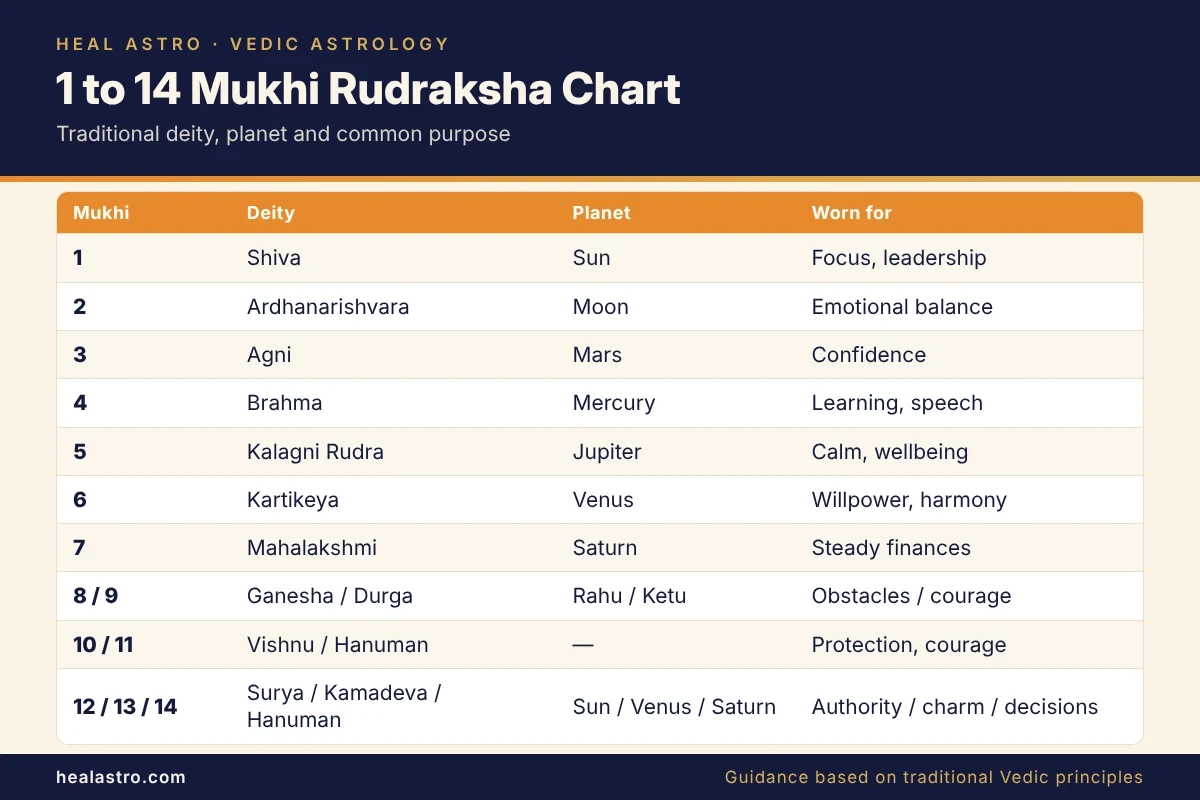
This table lists each mukhi with its traditional deity, ruling planet and the purpose people usually wear it for. These associations come from scriptural tradition and the practice of astrologers; different lineages vary slightly.
| Mukhi | Deity (traditional) | Planet | Usually worn for |
|---|---|---|---|
| 1 mukhi | Shiva | Sun | Focus, spiritual practice, leadership |
| 2 mukhi | Ardhanarishvara | Moon | Emotional balance, relationships |
| 3 mukhi | Agni | Mars | Confidence, letting go of past burdens |
| 4 mukhi | Brahma | Mercury | Learning, speech, memory for students |
| 5 mukhi | Kalagni Rudra | Jupiter | General wellbeing, calm, meditation |
| 6 mukhi | Kartikeya | Venus | Willpower, creativity, harmony at home |
| 7 mukhi | Mahalakshmi | Saturn | Steady finances, patience in hard phases |
| 8 mukhi | Ganesha | Rahu | Removing obstacles, new beginnings |
| 9 mukhi | Durga | Ketu | Courage, protection, inner strength |
| 10 mukhi | Vishnu | No single planet | Protection, peace from fear |
| 11 mukhi | Hanuman (Ekadasha Rudra) | No single planet | Courage, discipline, safe travel |
| 12 mukhi | Surya | Sun | Authority, energy, administration |
| 13 mukhi | Kamadeva / Indra | Venus | Charm, attraction, fulfilment of wishes |
| 14 mukhi | Hanuman / Shiva | Saturn | Intuition, decision-making, protection |
A Gauri Shankar rudraksha is two beads naturally joined, representing Shiva and Parvati. It is traditionally worn for harmony in marriage and family. A Ganesh rudraksha has a small trunk-like bump on its surface and is linked to removing obstacles.
The cleanest way to decide which rudraksha to wear is through your lagna lord, the planet that rules your ascendant. Strengthening it supports your health, confidence and general direction.
| Lagna (ascendant) | Lagna lord | Suggested mukhi |
|---|---|---|
| Aries, Scorpio | Mars | 3 mukhi |
| Taurus, Libra | Venus | 6 mukhi |
| Gemini, Virgo | Mercury | 4 mukhi |
| Cancer | Moon | 2 mukhi |
| Leo | Sun | 1 or 12 mukhi |
| Sagittarius, Pisces | Jupiter | 5 mukhi |
| Capricorn, Aquarius | Saturn | 7 or 14 mukhi |
Our astrologers also look at which planets are functional benefics for your lagna and which house lords you want to support, using the 12 houses of the birth chart. This is why two people born under the same Sun sign can be advised completely different beads.
If your kundli is not available, purpose is the next best way to decide which rudraksha to wear. Pick the bead that matches what you want to work on, then confirm with an astrologer when you can.
Browse Nepali and Indonesian rudraksha in our store
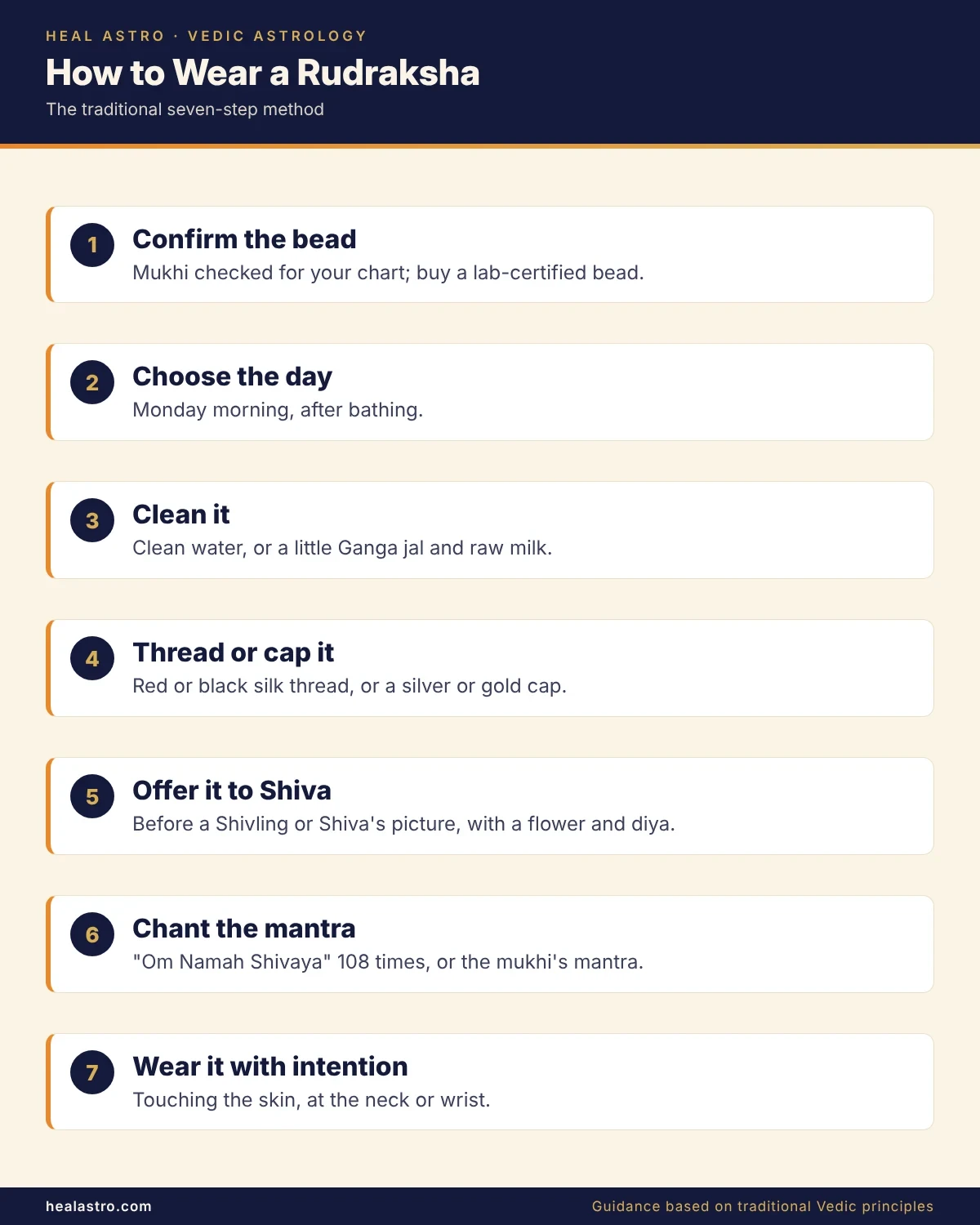
Wearing a rudraksha is simple, and the method matters more than the price. This is the traditional process most families follow.
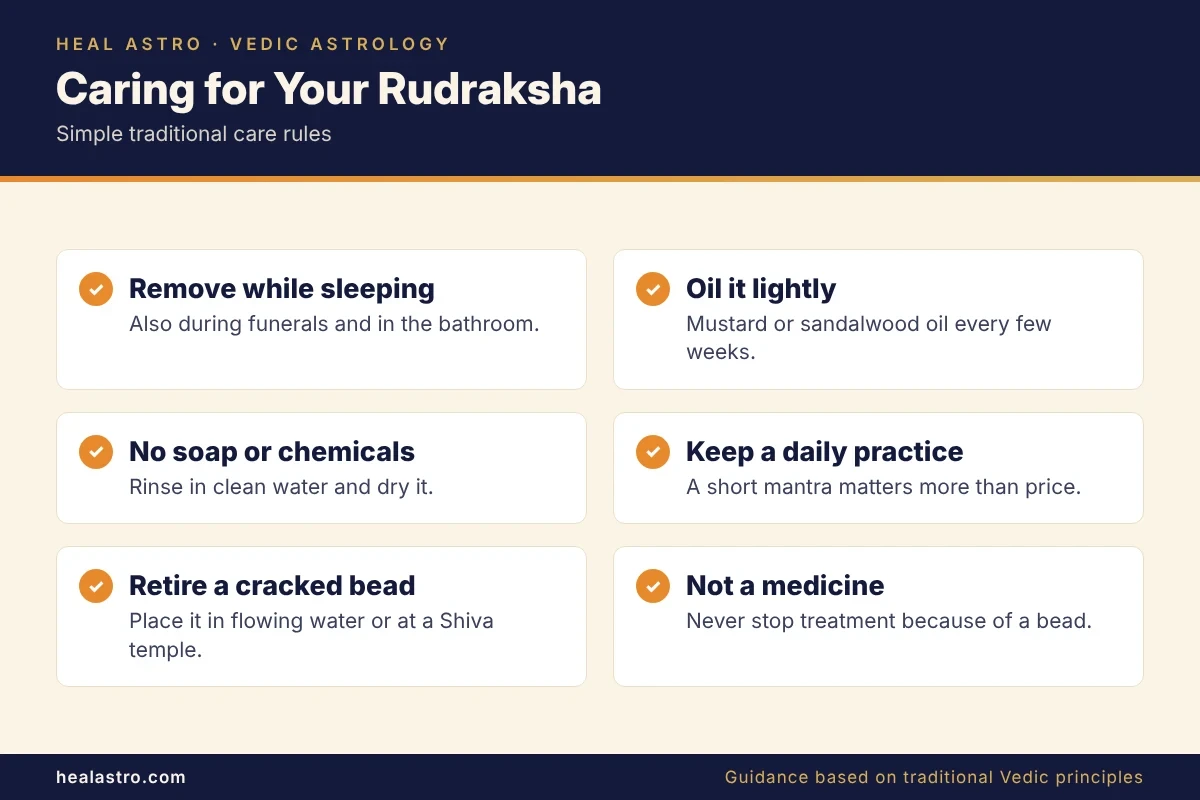
Tradition advises removing the bead while sleeping, during funerals and in the bathroom. Oil it lightly every few weeks with mustard or sandalwood oil to stop it drying out. Don't use soap or chemical cleaners. If a bead cracks badly, retire it with respect, usually by placing it in flowing water or at a Shiva temple.
Our guide to mantras lists the specific beej mantra traditionally recited for each mukhi.
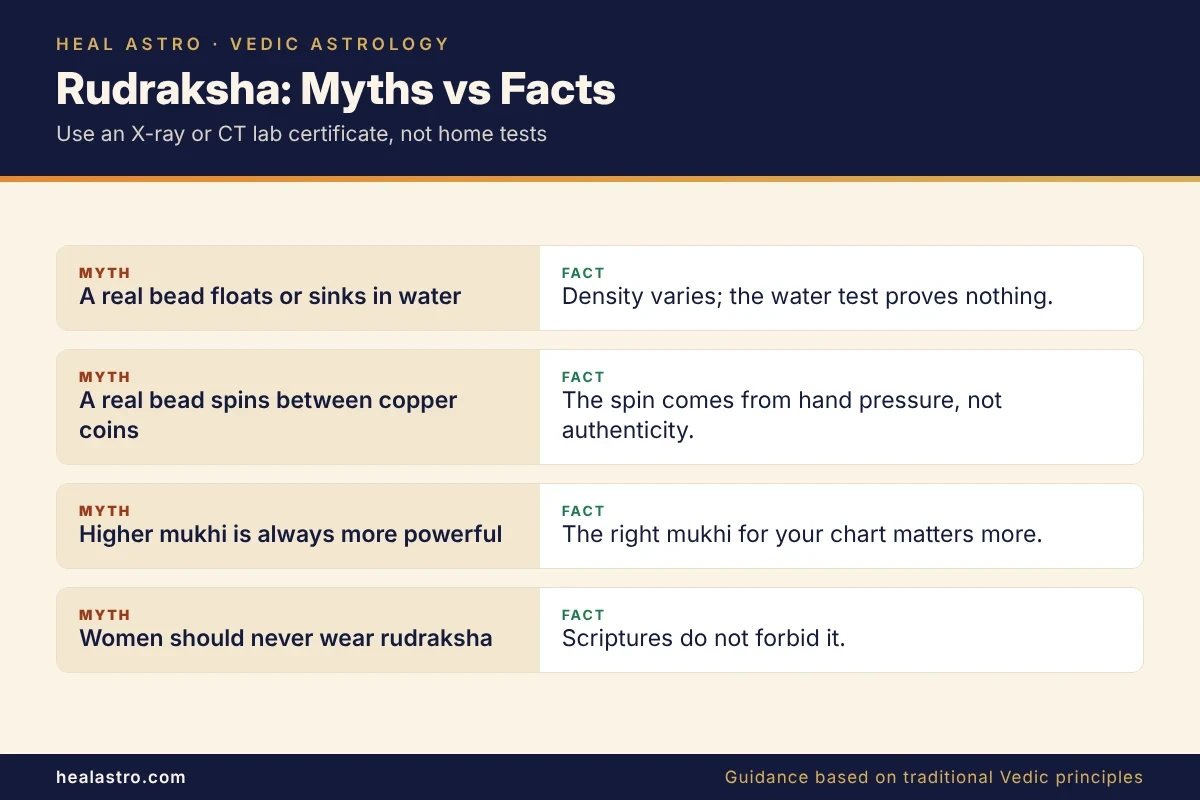
The rudraksha market is full of claims. These are the ones that mislead buyers most often.
| Myth | Fact |
|---|---|
| A real rudraksha floats or sinks in water | Density varies by bead and dryness. The water test proves nothing. |
| A real bead spins between two copper coins | The spin comes from hand pressure and balance, not authenticity. |
| Women should never wear rudraksha | Scriptures do not forbid it. Many women wear rudraksha daily. |
| Higher mukhi is always more powerful | Each mukhi has a different role. The right one for your chart matters more than the count. |
| One mukhi round beads are easy to find | Genuine round 1 mukhi beads are extremely rare. Most sold are half-moon (Indonesian) or fake. |
| Anyone can wear any rudraksha | Most beads are safe, but those linked to Rahu, Ketu or Saturn are better worn after a chart check. |
Many sellers recommend a "power combination" of six or seven beads to every customer. We disagree. One correctly chosen bead worn with discipline is better than an expensive combination chosen by a sales pitch.
This is an illustrative example, not a real client.
Consider a 20-year-old in Patna preparing for a competitive exam. A relative gifted him a 7 mukhi, saying it brings success. He felt restless and wanted to know if it was right.
His chart had Gemini lagna, with Mercury, the lagna lord, in the 5th house in Libra. Saturn, which rules the 8th and 9th for Gemini, was placed in the 12th. An astrologer would suggest a 4 mukhi to support Mercury, which rules his lagna and also the 4th house of education. The 7 mukhi isn't harmful for him, but it supports a planet that isn't the priority right now.
The practical part of the advice would matter just as much: a fixed study routine, wearing the bead after a Monday morning puja, and chanting the Budh mantra on Wednesdays.
Rudraksha is generally considered gentle and safe. Still, a few situations call for care before you settle on which rudraksha to wear.
If you are running a Rahu or Saturn period and want an 8, 7 or 14 mukhi, let an astrologer check the chart first. The same applies to anyone combining rudraksha with gemstones, because strengthening the same planet twice may not suit your chart. And please don't stop any medical treatment because of a rudraksha. It is a spiritual practice, not medicine.
People in Varanasi, Kolkata, Delhi NCR, Mumbai, Bengaluru, Jaipur and Bhopal often tell us that local markets are full of beads with no proof of origin. Buying online from a store that provides lab certification and clear mukhi photos is often safer than buying in person.
The consultation can happen online too. An astrologer only needs your birth details to suggest a mukhi, and you can confirm the choice on a call or over chat before ordering.
Your date of birth alone isn't enough; you need your birth time and place to find your lagna. The rudraksha linked to your lagna lord is usually the best start: 3 mukhi for Mars, 6 for Venus, 4 for Mercury, 2 for the Moon, 1 or 12 for the Sun, 5 for Jupiter, 7 or 14 for Saturn.
The 5 mukhi rudraksha is considered safe for almost everyone. It is linked with Jupiter and Kalagni Rudra and is traditionally worn for calm, wellbeing and meditation. It is also the bead most commonly used in jap malas. Most astrologers suggest it when the birth chart is not available.
Yes, women can wear rudraksha. No major scripture forbids it, and many women wear rudraksha daily for spiritual practice. Some families follow a custom of removing it during menstruation; this is a matter of personal and family tradition rather than a scriptural rule.
The reliable way is a lab certificate based on X-ray or CT imaging, which shows the internal seed chambers matching the mukhi count. Water-floating and copper-coin tests are not reliable. Buy from a seller who shows clear photos of every face and provides a certificate.
Yes, you can wear more than one rudraksha, and combinations are common. However, each bead should suit your chart. Combining several beads linked to the same planet, or adding gemstones for that planet, may overdo it. An astrologer can suggest a balanced combination for your lagna.
For career, the 1 or 12 mukhi (Sun) is traditionally worn for authority and recognition, and the 14 mukhi for decision-making. The right choice depends on your 10th house and its lord. Deciding which rudraksha to wear for career is best done with a quick chart check.
The general mantra is "Om Namah Shivaya," chanted 108 times before wearing the bead. Each mukhi also has its own traditional beej mantra, such as "Om Hreem Namah" for the 5 mukhi. Chant on a Monday morning after bathing, ideally in front of a Shivling or Shiva's picture.
Deciding which rudraksha to wear gets easy once you know your lagna and the planet you want to support. Start with the 5 mukhi if you are unsure, buy only certified beads, and wear it with a short daily practice rather than as a lucky charm.
If you want a personal recommendation, speak to one of our astrologers. They will read your chart and tell you which mukhi suits you, and which ones don't.
Talk to a HealAstro astrologer about the right rudraksha
When you're ready, choose from our rudraksha collection, or book a Gauri Shankar puja for family harmony.
Disclaimer: Astrology offers guidance based on traditional Vedic principles. It is not a substitute for medical, legal, financial or psychological advice, and no astrologer can guarantee an outcome.