
Key points at a glance
A family sits across from a pandit in Nashik. Their son is 31, earns well, has no rishta that sticks. The kundli is opened, the pandit goes quiet, then says the words every parent dreads: "kaal sarp dosh". Most families leave that room frightened and with a long list of expensive upay (remedies). We have seen this scene many times, and we think it goes wrong more often than it goes right.
This guide explains what kaal sarp dosh actually is, how to check it in your own chart, which of the 12 types you may have, and what a sensible remedy looks like. If you want a quick look first, our free kundli tool shows where Rahu and Ketu sit. For the wider picture of dosh in a chart, start with our planetary doshas guide.
Ask our astrologers to check your kaal sarp dosh
Kaal sarp dosh is a Vedic astrology combination in which all seven planets (Sun, Moon, Mars, Mercury, Jupiter, Venus, Saturn) fall between Rahu and Ketu in a birth chart. Rahu and Ketu are always 180 degrees apart. When every other planet sits on one side of that line, the chart is said to carry kaal sarp dosh. The name means "serpent of time".
Think of Rahu as the serpent's head and Ketu as its tail. The planets are inside the coil. That is the picture the tradition uses, and it explains why the effects are described as feeling "stuck".
One honest point first. Kaal sarp dosh is not named as such in the Brihat Parashara Hora Shastra, the main classical text most astrologers rely on. It became popular through later teachers and regional practice. Some astrologers treat it as a major dosh, others barely mention it. We take a middle position: it is a real pattern worth reading, but it is never a verdict by itself.
You can check kaal sarp dosh in five steps, and it takes about ten minutes once you have an accurate chart.
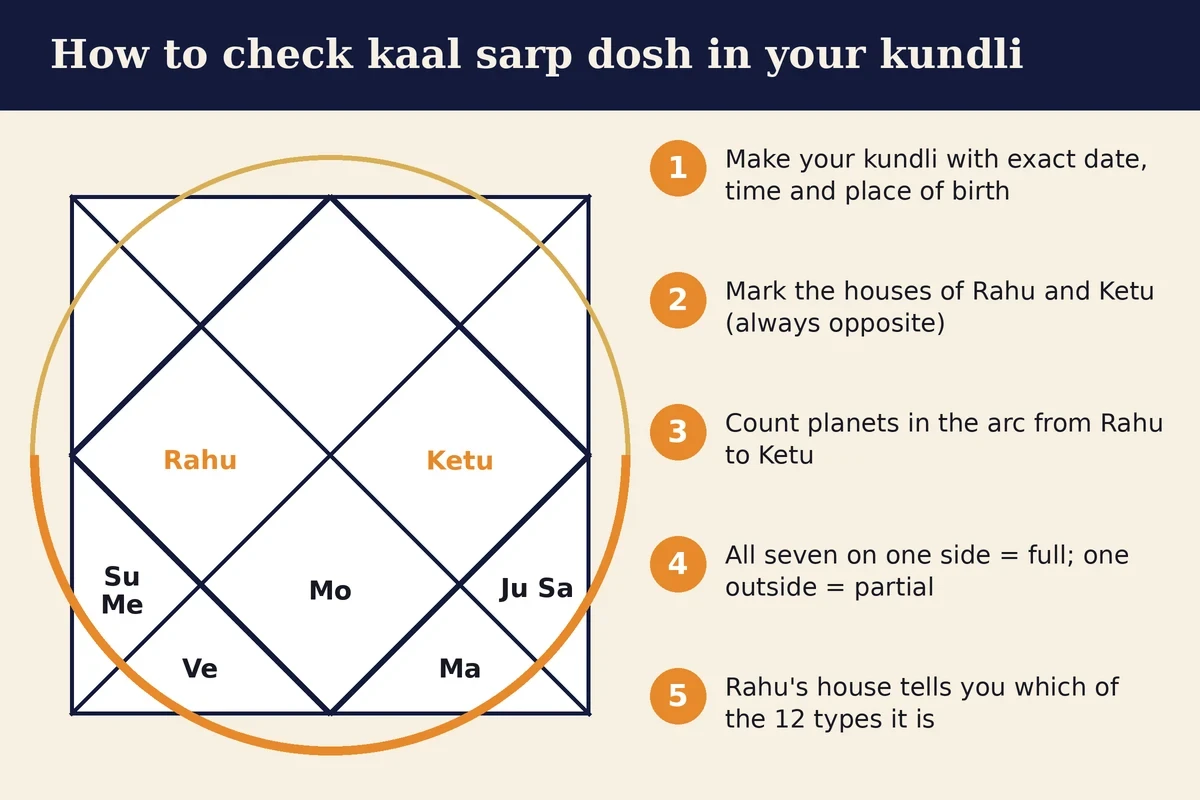
Direction matters. Planets between Rahu and Ketu going forward through the zodiac are the classic form. Planets between Ketu and Rahu form what some call the "reverse" type, which many astrologers read as milder. Not everyone agrees on this, and we say so to clients.
Birth time is the weak spot. Rahu and Ketu move slowly, but the Moon changes sign every two to three days and the ascendant (lagna) changes roughly every two hours. A birth time off by 20 minutes can shift a planet across a house boundary and change the whole reading. If your time is approximate, tell your astrologer.
The 12 types of kaal sarp dosh are named by the house Rahu occupies, from the first house to the twelfth. The table below is the traditional list, with the area of life each is said to touch most.
| Rahu in house | Type | Area traditionally affected |
|---|---|---|
| 1st | Anant | Self-image, health of mind, marriage |
| 2nd | Kulik | Family wealth, speech, savings |
| 3rd | Vasuki | Siblings, courage, short travel |
| 4th | Shankhpal | Home, mother, property, peace |
| 5th | Padma | Children, education, romance |
| 6th | Mahapadma | Debts, rivals, daily work |
| 7th | Takshak | Marriage and partnerships |
| 8th | Karkotak | Sudden change, inheritance, longevity worries |
| 9th | Shankhchud | Luck, father, higher learning |
| 10th | Ghatak | Career, status, public image |
| 11th | Vishdhar | Gains, friends, elder siblings |
| 12th | Sheshnag | Foreign lands, sleep, hidden expenses |
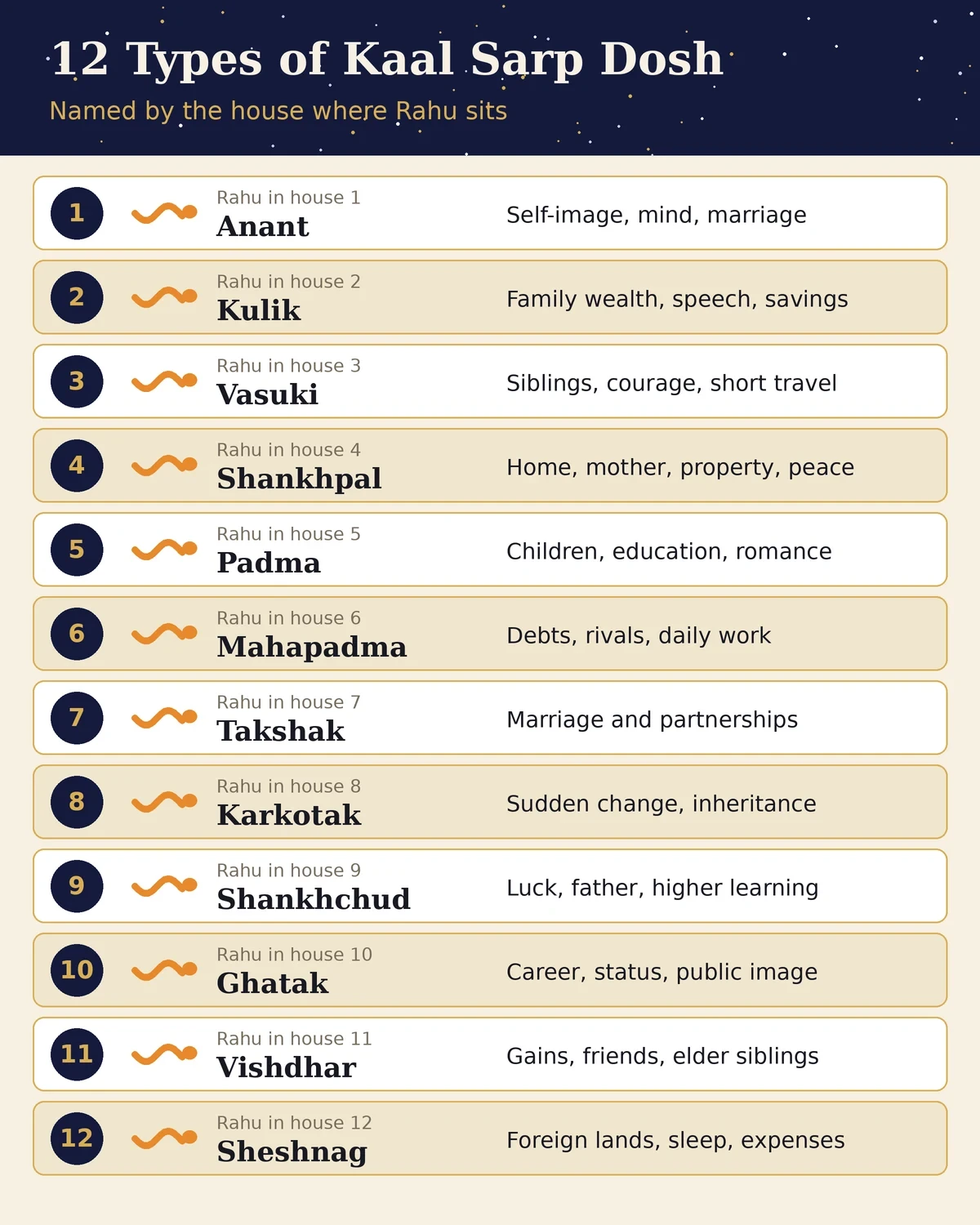
Names and spellings differ between regions, and some teachers place the list slightly differently. Treat the house, not the serpent's name, as the useful part. You can read more about what each house controls in our guide to the 12 houses in Vedic astrology.
The traditional effects of kaal sarp dosh are delay, repeated restarts and restlessness, and they are said to peak during the Rahu or Ketu mahadasha (major planetary period) or antardasha (sub-period).
People often describe the same pattern. Work starts well and stalls. A rishta looks settled, then collapses. Savings build, then a sudden expense eats them. Sleep is light. Many say life feels like climbing a staircase that moves down.
Here is where we disagree with a lot of websites. They list frightening outcomes such as lifelong failure or loss of children. We do not write that, and we do not believe it. A hemmed chart concentrates a person's karma into a narrower channel. That can mean delay, but it can also mean intense focus. Many people with this pattern are persistent, private and unusually driven, and some do their best work after 36 or 40.
Which planets sit inside the coil matters more than the label. Rahu with a strong Jupiter in the 10th reads very differently from Rahu hemmed against a weak Moon in the 4th.
Kaal sarp dosh is considered weakened when a planet escapes the Rahu-Ketu arc, when a planet sits very close to Rahu or Ketu, or when Jupiter or the Moon is strong. Our astrologers look for these before suggesting any remedy.
Dasha timing also decides whether this is a problem at all. A person with the pattern who is running a Jupiter or Venus mahadasha may feel almost nothing. The same chart in Rahu mahadasha can feel heavy. Always read the dosh together with the running dasha.
This is an illustrative case, not a real client. A woman, 29, in Pune has Rahu in the 7th house and Ketu in the 1st, with the seven planets between them. Her family has rejected two proposals because a pandit called her chart "kaal sarp". Our astrologer notices that Jupiter sits in the 10th house in Cancer, its sign of exaltation, and the Moon is not afflicted. The Venus-Rahu conjunction is within a few degrees, so Venus is not clearly hemmed.
The reading is therefore Takshak type, but softened. The advice is not an expensive ritual. It is to check kundli matching with a partner whose Rahu-Ketu axis is not the same, to wait out the current Saturn-Rahu antardasha, and to keep a simple Monday Shiva routine if the family wants one. The point of the example is the method: look at the whole chart before reacting to one label. Compare this approach with how the Manglik dosha guide treats cancellation rules.
Get your complete kundli reading from our astrologers
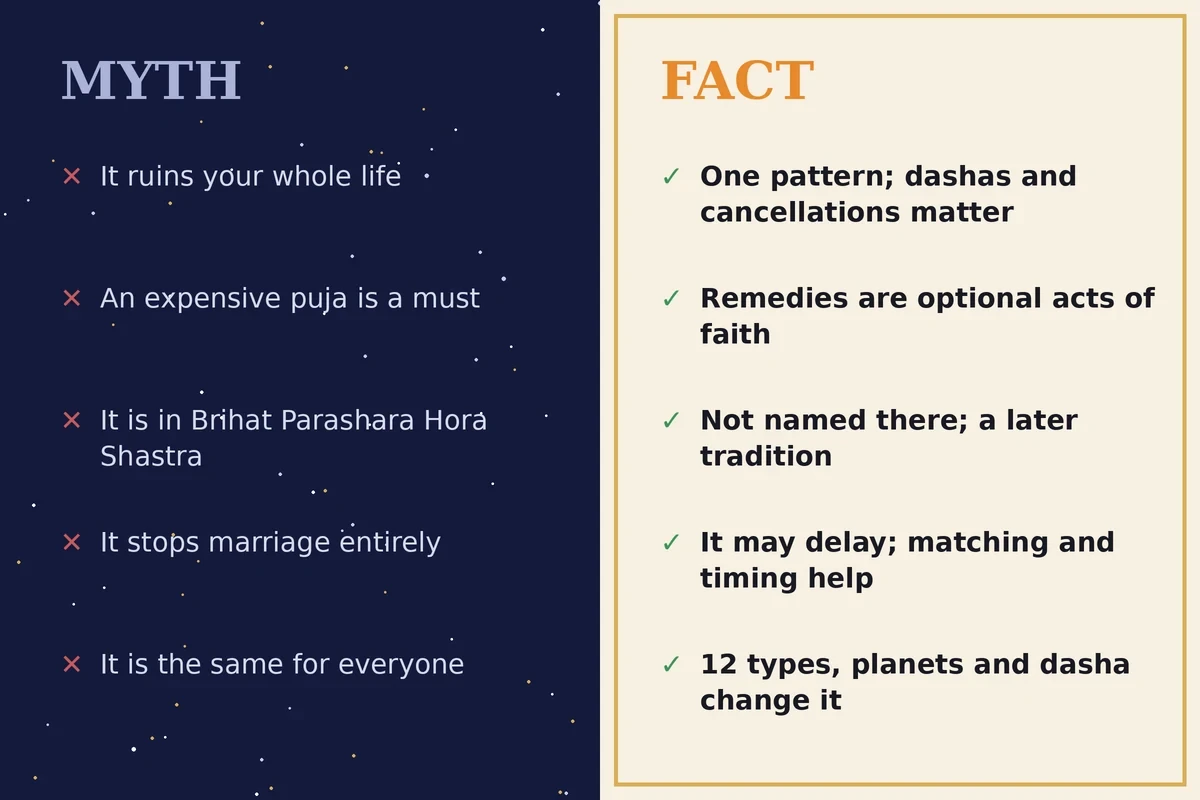
Most of the fear around this dosh comes from half-truths repeated by paid-ritual sellers. The table separates what the tradition says from what it does not.
| Myth | Fact |
|---|---|
| Kaal sarp dosh ruins the whole life. | It is one pattern among many. Planet strength, dashas and cancellations change the result a great deal. |
| Everyone with it must do an expensive puja. | Remedies are optional acts of faith. Many charts need only awareness and patience. |
| It is described in detail in Brihat Parashara Hora Shastra. | It is not named there. It comes from later tradition and is debated. |
| It stops marriage entirely. | It can delay it, but careful matching and timing often resolve it. |
| It is the same for everyone. | The 12 types, the planets inside the coil and the dasha all change the reading. |
| Only a priest in one temple can fix it. | No single place or person holds the answer. Faith and consistency matter to those who practise. |
The remedies for kaal sarp dosh in tradition are Shiva worship, Rahu and Ketu mantras, charity and, for those who wish, a puja. They are acts of faith and discipline. They cannot guarantee any outcome, and none replaces practical steps like career planning, medical care or counselling.
If you are also running Saturn's seven-and-a-half-year period, read our guide on Shani Sade Sati, since the two can overlap. And if ancestors are a concern in your family, our Pitra dosh article explains the separate checks for that.
Readers in Delhi NCR, Mumbai, Jaipur, Lucknow, Kolkata, Bengaluru and Hyderabad ask us about kaal sarp dosh every week, and an online consultation works just as well as a visit. Your kundli is a set of calculations, not a place. Once we have your exact birth details, the chart reads the same on a video call as it does across a table.
Families in Jaipur and Lucknow often arrive after a pandit has already named the dosh. Readers in Bengaluru and Hyderabad tend to ask about career delays. In Kolkata and Mumbai, marriage timing comes up most. Whichever it is, we start with the same two questions: is the dosh really full, and what dasha is running now.
Start with a correct chart, then get a second opinion before spending on any ritual. A reading should tell you the type, the planets inside the coil, any cancellations and the running dasha. If a reading cannot tell you those four things, ask for another.
Keep the list of your questions short. Is this career, marriage, money or peace of mind? One focus gives a clear answer. Many readers also find it useful to look at a 5-year prediction report to see when the heavy period eases.
It is a chart pattern where all seven planets sit between Rahu and Ketu. Traditionally it is linked with delays and restlessness. Its strength depends on the type, planet positions and running dasha, so it should never be judged from the label alone.
Look at your kundli. If every planet from Sun to Saturn lies on one side of the Rahu-Ketu axis, you have it. If one planet is outside, it is partial. An astrologer can confirm using your exact birth time, because small timing errors can change the result.
There are 12, named by the house Rahu occupies: Anant, Kulik, Vasuki, Shankhpal, Padma, Mahapadma, Takshak, Karkotak, Shankhchud, Ghatak, Vishdhar and Sheshnag. Names can vary slightly between regions, but the house placement is what guides the reading.
No, not in the way some websites say. It is a traditional indication of delay and pressure, not a sentence. Many people with this pattern lead stable, successful lives. Its effect depends on other planets, cancellations and dashas. Fear-based claims are not part of sound practice.
Yes, partly or fully, according to tradition. A planet outside the axis, a planet very close to Rahu or Ketu, a strong Jupiter or a well-placed Moon can all reduce it. We check these before suggesting any remedy.
It can be linked with delay or repeated breaks in proposals, especially with Rahu in the 1st or 7th house. It does not make marriage impossible. Careful kundli matching and timing usually matter more than the dosh itself.
There is no single best remedy. Traditional practices include Shiva worship, Mahamrityunjay or Rahu-Ketu mantras, charity and a puja. These are acts of faith and cannot guarantee a result. Start with the simplest practice you can keep up.
No, not by that name. It developed in later astrological tradition, so astrologers differ on how much weight to give it. We treat it as one pattern to read alongside the whole chart.
Kaal sarp dosh deserves a careful look, not panic. If you want an honest answer on whether your chart has it, which type it is and whether any remedy is worth your money, talk to a HealAstro astrologer with your exact birth details. If you prefer to read at your own pace, the HealAstro app on Android gives you your kundli and daily guidance on your phone.
Disclaimer: Astrology offers guidance based on traditional Vedic principles. It is not a substitute for medical, legal, financial or psychological advice, and no astrologer can guarantee an outcome.