Key points at a glance
A call comes at 11 p.m. A father in Kanpur has been admitted for a heart procedure, and the whole family is awake. Someone's aunt says, "Start the Mahamrityunjay mantra tonight." Nobody in the room is sure of the words, the count or the rules. If this is where you are, we have written this for you. Our astrologers get this question often, usually next to a kundli (birth chart) that shows a heavy planetary dosha period, and we try to answer it plainly: what the mantra says, how to chant it, and what it can and cannot do.
Book a one-to-one 1,25,000 Mahamrityunjay Mantra Jaap with HealAstro pandits
The Mahamrityunjay mantra is a Sanskrit verse addressed to Shiva as Tryambaka, the three-eyed lord, asking to be freed from death's bondage the way a ripe cucumber slips from its stem. It is also called the Tryambakam mantra and, in some traditions, the Rudra mantra. Devotees chant it for protection, steadiness in illness or danger, and peace of mind. It is one of the most widely recited mantras in India.
The verse is short, and knowing each word changes how you chant it.
Mantra (as commonly chanted):
Om Tryambakam yajamahe sugandhim pushtivardhanam, urvarukamiva bandhanan mrityor mukshiya mamritat.
| Sanskrit word | Plain meaning |
|---|---|
| Tryambakam | The three-eyed one, a name of Rudra-Shiva |
| Yajamahe | We worship, we offer our devotion |
| Sugandhim | Fragrant, full of goodness |
| Pushtivardhanam | The one who nourishes and increases wellbeing |
| Urvarukam iva | Like a ripe cucumber |
| Bandhanat | From its bond, its stem |
| Mrityor mukshiya | May I be freed from death |
| Ma amritat | Not from immortality |

Read the last line again. The prayer does not ask to escape death by force. It asks that the fear of death, and attachment to the body, fall away naturally when the time is ripe, while the soul stays connected to what is deathless. A ripe cucumber is not pulled off the vine. It simply lets go.
This is where we disagree with many websites. They sell the mantra as a long-life switch. The verse itself does not say that. It is a prayer for release from bondage and for being nourished, and the sensible way to chant it is as that kind of prayer.
The mantra is Rigveda, Mandala 7, Sukta 59, verse 12, and the hymn is attributed to the sage Vasishtha. The same verse appears in the Yajurveda (Taittiriya Samhita 1.8.6 and the Vajasaneyi Samhita 3.60). In the Vedic ritual setting, it closes an offering to Rudra Tryambaka at the end of the Chaturmasya sacrifices.
Later Puranic tradition built many stories around the verse and gave it the name "Maha" (great) Mrityunjay (conqueror of death). The Vedic verse itself starts at "Tryambakam". The "Om" at the front is how it is usually spoken today in devotional chanting.
Vedic astrologers prescribe this mantra as a traditional remedy when a chart shows prolonged strain, and the Brihat Parashara Hora Shastra itself lists Mrityunjaya japa among the remedies for difficult Saturn and Rahu sub-periods (Chapter 57 in common editions). We look at a few things in a chart before suggesting it.
The 8th house and its lord. The 8th house governs sudden events, long illness, fear and transformation. If the 8th lord sits in the 6th, 8th or 12th, or if Saturn or Rahu aspects it, the person often carries a background anxiety that has no clear cause. Our guide to the 12 houses in Vedic astrology explains what each house rules.
Maraka lords. The 2nd and 7th lords are called maraka (death-inflicting) in classical texts. When their dasha or antardasha runs together with a weak Saturn, many families feel the fear without understanding the cause. We do not read this as a prediction of death. We read it as a period needing care and extra attention to health check-ups.
Saturn and Rahu periods. Shani mahadasha, Rahu mahadasha and Sade Sati are the usual triggers. Rahu especially can bring health fears that feel larger than they are.
Lagna lord weakness. A lagna lord in a dusthana (6th, 8th or 12th house), or afflicted by Mars or Rahu, can make the person feel unprotected.
You can see where these planets sit in your own chart with a free kundli on HealAstro. A reading of what the chart actually shows should come before any remedy.
Get your full chart reviewed with the Complete Kundli Report
Most chanting mistakes come from rushing, so start with the setup and the count, not the speed.
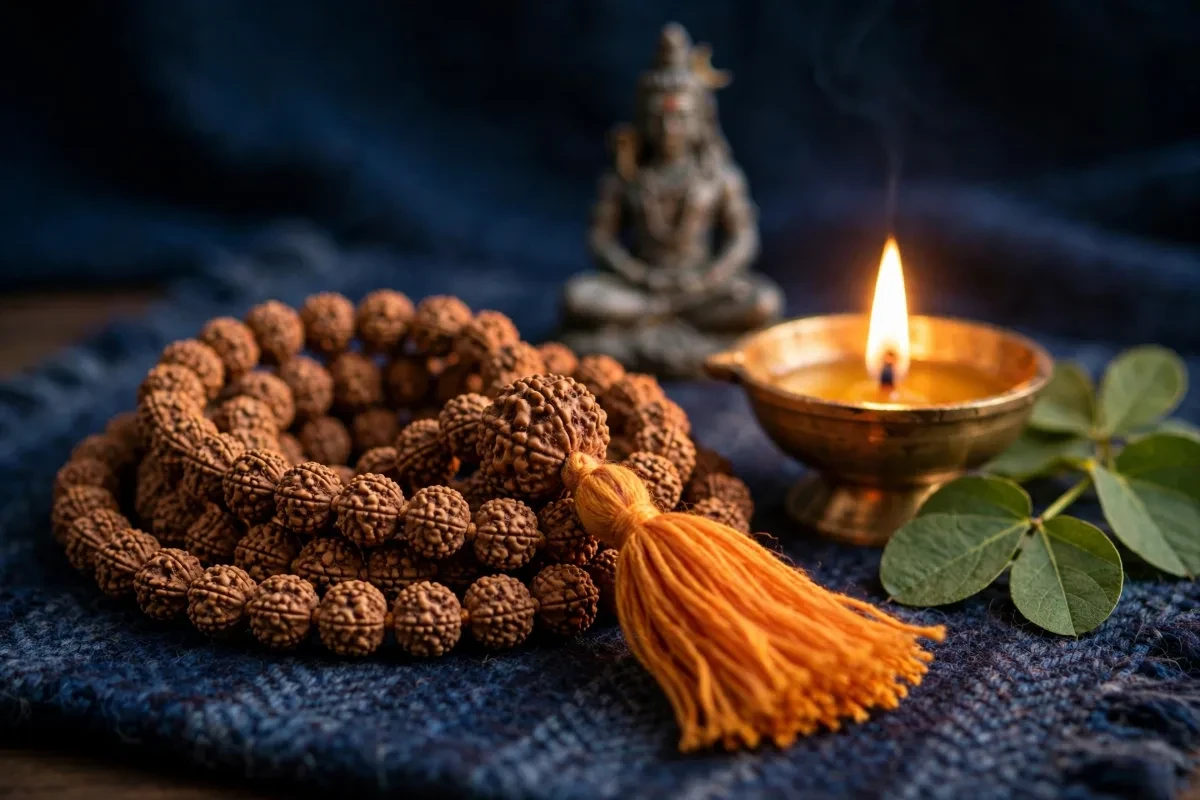
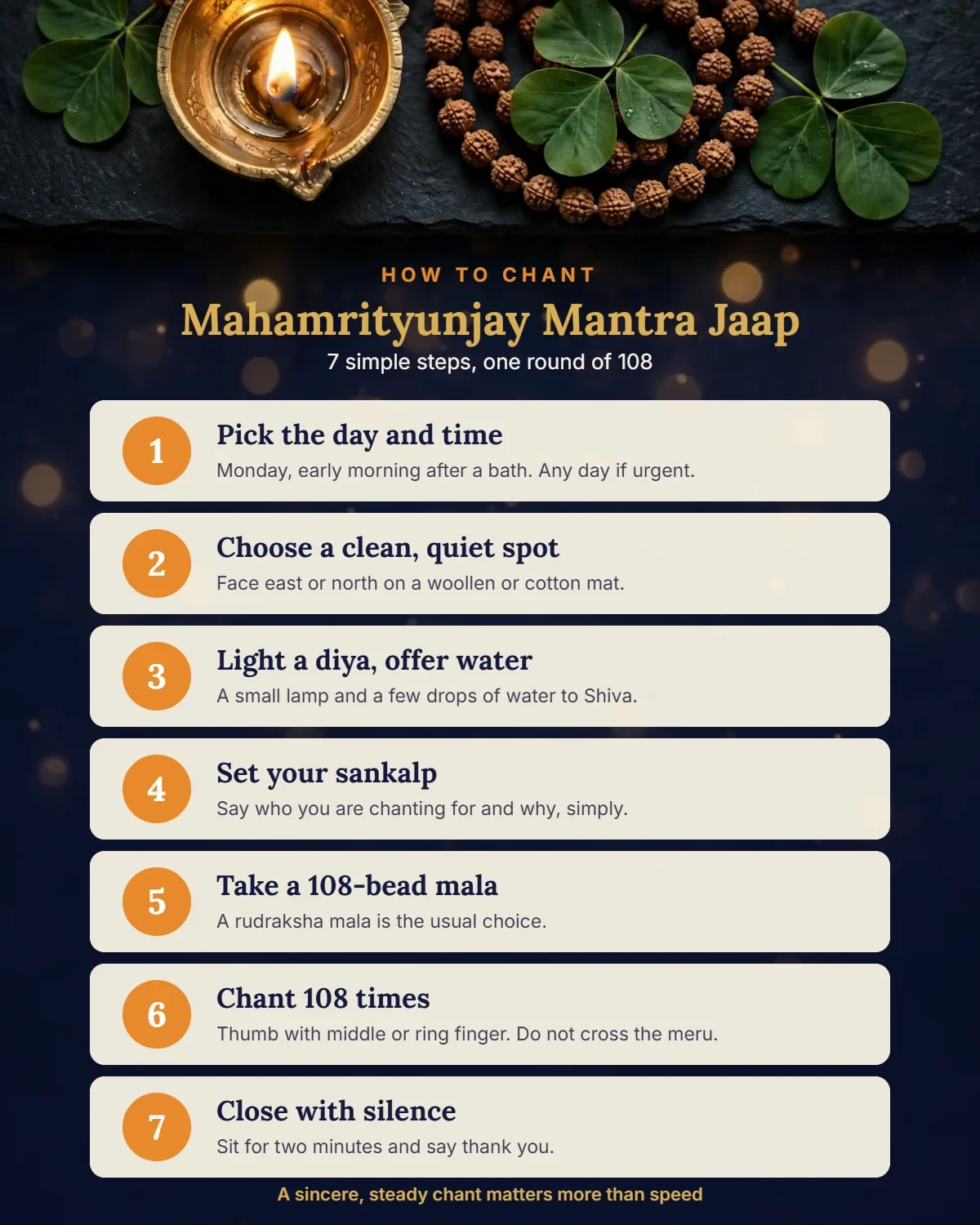
Pronounce slowly and clearly. Do not worry about perfect Sanskrit on the first day. A sincere, steady chant matters more than a fast, flawless one. If a word keeps tripping you, a short recording from a pandit or a call with our team can help.
Devotees describe a calmer mind, steadier breathing while chanting, and a sense of being protected during a stressful stretch. Those are the benefits people report, and they are personal. We do not publish numbers, and we do not know of research that proves a mantra changes a medical outcome.
What the tradition does say is that the mantra is a protective prayer to Shiva. Families chant it when someone is unwell, before surgery, at the start of a Sade Sati phase, or when a mahadasha feels heavy. In every one of those cases, the doctor leads the treatment and the mantra is the family's spiritual support alongside it.
| Myth | Fact |
|---|---|
| The mantra guarantees a long life | The verse asks for release from the fear of death, and no astrologer can guarantee an outcome |
| It can replace a doctor or a hospital stay | It is a prayer. Medical care comes first, always |
| Only brahmins or men can chant it | Anyone with faith can chant it, women and men, at home |
| You must chant it exactly 1,25,000 times | 108 times a day is a complete daily practice. Large counts like 1,25,000 are done in a formal jaap by pandits over several days |
| One missed word ruins it | Sincerity matters more. Correct the word next time and carry on |
| Chanting works faster if you rush | Slow, clear chanting is what the texts ask for |
This is a made-up example to show how we think, and it is not a real client.
Imagine a 38-year-old woman in Pune whose mother has a long-running heart condition. Her kundli shows Saturn in the 8th house, running its mahadasha, with Rahu in the lagna. She is exhausted and keeps checking her phone for hospital updates. Our astrologers would first ask her to confirm her birth time, because a lagna that moves by one sign changes the reading completely. If the chart holds, we would say that the 8th-house Saturn explains the heaviness she feels, and suggest one round of the mantra each morning, plus Saturday visits to a Shiva or Hanuman temple. We would also tell her, clearly, that her mother's cardiologist makes the medical decisions, and that nothing in the chart replaces that.
You do not need to travel to Haridwar, Ujjain or Varanasi for a proper jaap. Readers in Delhi NCR, Mumbai, Bengaluru, Hyderabad, Pune, Jaipur and Lucknow now book pandits online, watch the sankalp over video and have the chant done in their family's name. Online consultation works just as well for reading the chart. The mantra does not depend on the postcode of the person chanting, and a good astrologer needs your birth details, not your presence in the room.
If you want a pandit to chant on your behalf, a one-to-one session gives you the sankalp in your name. If you prefer to chant yourself, our astrologers can set the count and timing around your chart.
Talk to a HealAstro astrologer about the right mantra count for your chart
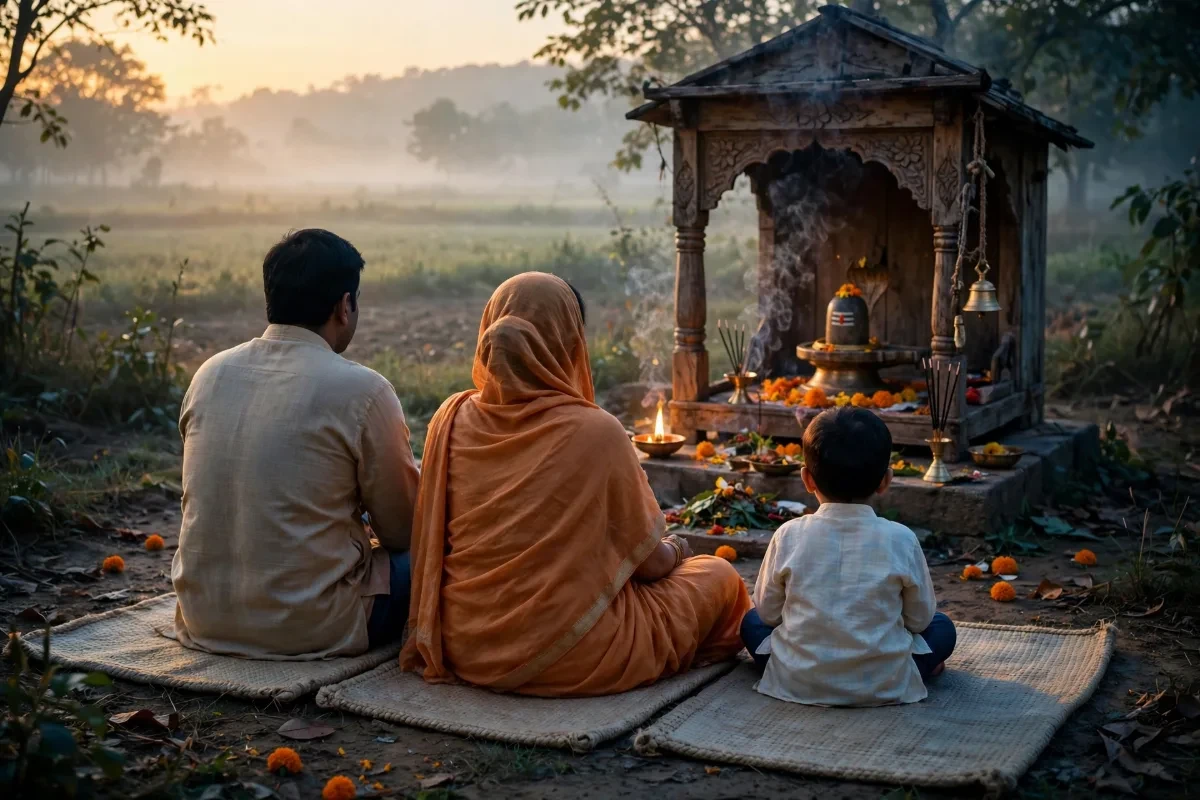
These are traditional practices and acts of faith. They cannot guarantee an outcome, and none of them is a medical step.
It is a Rigvedic verse to Shiva as Tryambaka. It asks to be freed from the bond of death like a ripe cucumber from its stem, while staying connected to what is immortal. Devotees chant it for protection, peace and strength during illness, fear or a hard planetary period.
One mala of 108 repetitions is the standard daily count. Many people do 11, 21 or 51 rounds during a difficult period or for a special sankalp. Pick a number you can keep up. A smaller count every day is better than a large count done once.
Monday is considered best because it belongs to Shiva. Early morning after a bath is the usual time. In an urgent situation, you can begin on any day and at any hour, since the mantra is a prayer for protection and does not need a perfect muhurat.
Yes. The practice is open to anyone with faith, women and men alike, at home or in a temple. Keep your body clean, your mind calm and your pronunciation as clear as you can. Many families have the mother or grandmother lead the household chanting.
No. It is a spiritual practice, and we do not claim it treats any disease. Medical care should always come first. Many families chant it for emotional strength and peace of mind while the doctor handles treatment, and that is a sensible way to use it.
No. Despite its name, devotees chant it for protection, health of mind, steadiness through Sade Sati or Rahu dasha, and general wellbeing. The "mrityu" in the name points to the deeper fear of loss and endings, which almost everyone feels at some point.
Not automatically. A dosha is one factor in a chart and needs a full reading before any remedy is chosen. Our astrologers look at the dasha running, the house placements and your birth time accuracy first, then suggest a mantra, puja or neither.
The Mahamrityunjay mantra is worth learning properly: the words, the 108 count, the calm and the daily habit. It will not take away a doctor's role or a chart's real challenges, but it gives a worried family something steady to do with their hands and voice.
If you want a pandit to chant it for you, the 1,25,000 Mahamrityunjay Mantra Jaap above carries the sankalp in your family's name, and our protection puja options cover other prayers for a family under strain. If you would rather keep the mantra and the chart reading together, download the HealAstro app and speak to our astrologers from home.
Disclaimer: Astrology offers guidance based on traditional Vedic principles. It is not a substitute for medical, legal, financial or psychological advice, and no astrologer can guarantee an outcome.